Final Grade Calculator — Final Mark Calculator
Try the Final Grade Calculator to know your desired grade. Enter your current grade, your target grade, and the weight of your final exam. Get the exact score you need to pass, improve, or ace the class.
Free. Works for high school, college, and university courses.
Finals week is stressful. You have multiple exams, limited time, and no clear picture of where you stand. This calculator gives you that picture in seconds. Know the exact score you need. Then study with a plan, not a panic.
What is a final grade calculator
A final grade calculator tells you the minimum score you need on your final exam to reach a specific grade in a course. You enter your current grade, your goal grade, and the weight of the final exam. The calculator runs the formula and shows your required score instantly.
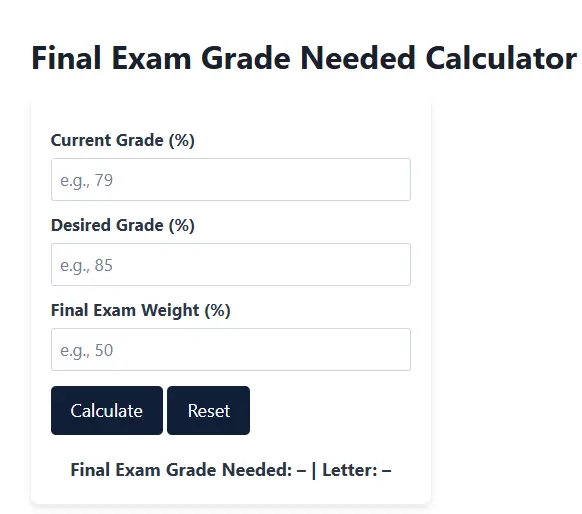
Example:
If you scored 85% in your assignments and 90% on your final exam, our Final Grade Calculator with weights will compute your overall grade, factoring in the weight of each component.
How to Use the Final Grade Calculator
Three inputs. One result. Here is the exact process:
- Enter your current grade
This is your grade going into the final exam, before the exam is taken. Check your gradebook or ask your teacher. - Enter your target grade
the overall course grade you want to finish with. This can be a letter grade or a percentage. - Enter the final exam weight
This is how much the final counts toward your overall course grade. You will find this number in your course syllabus. A common weight is 20%, 30%, or 40%. - Read your required score
The calculator shows the exact percentage you need on the final exam to hit your target.
Where do I find my final exam weight?
Check your course syllabus. Your teacher or professor lists the weight of each assignment, test, and exam at the start of the semester. The final exam weight is almost always listed as a percentage. If you cannot find it, ask your instructor directly.
Final Mark Calculator — Convert Your Mark to a Final Grade
In the UK, Canada, and Australia, teachers and professors use the word “mark” instead of “grade.” A mark means the same thing — the score you receive on an assignment, exam, or course overall. This calculator works identically for marks and grades.
If your teacher has given you a mark out of 100, enter it directly as your current grade. If your mark is out of a different total — say 65 out of 80 — convert it to a percentage first using our free Percentage Calculator, then enter that percentage here.
What is the difference between a mark and a grade?
A mark is the score given on a specific piece of work, usually as a number. A grade is the letter or percentage that represents your overall standing in a course. In the UK, Canada, and Australia the word “mark” is used more commonly, where US schools would say “grade.” Both refer to the same academic measurement.
How Marks Work in UK, Canadian, and Australian Schools
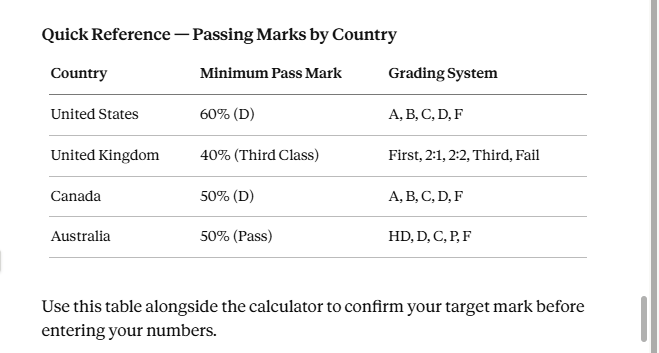
Every country uses a slightly different scale. Here is what you need to know before entering your numbers.
United Kingdom
UK universities use a classification system based on percentage marks rather than letter grades.
| Mark | Classification |
|---|---|
| 70% and above | First Class Honours (1st) |
| 60% to 69% | Upper Second Class Honours (2:1) |
| 50% to 59% | Lower Second Class Honours (2:2) |
| 40% to 49% | Third Class Honours (3rd) |
| Below 40% | Fail |
The pass mark at most UK universities is 40%. Some courses and institutions set it at 50%. Always check your specific course handbook for the exact figure. (Source: Universities and Colleges Admissions Service — UCAS)
What is a passing mark in the UK?
In most UK universities, a passing mark is 40%. Some courses and institutions require 50% to pass. Always check your specific course handbook or ask your department directly for the exact pass mark on your program.
Canada
Grading in Canada varies by province and institution, but most universities use a percentage system close to the US scale.
| Mark | Letter Grade | Description |
|---|---|---|
| 90% to 100% | A+ | Exceptional |
| 80% to 89% | A | Excellent |
| 70% to 79% | B | Good |
| 60% to 69% | C | Satisfactory |
| 50% to 59% | D | Marginal Pass |
| Below 50% | F | Fail |
The passing mark at most Canadian universities is 50%, compared to 60% in most US schools. Some programs — particularly in medicine, law, and engineering — set higher minimum pass marks. Check your institution’s academic calendar for your program’s exact requirement. (Source: Association of Universities and Colleges of Canada)
What is a passing mark in Canada?
In most Canadian universities and colleges, a passing mark is 50%. Some programs and institutions require a minimum of 60% to pass. Check your institution’s academic calendar or student handbook for the exact requirement in your specific program.
Australia
Australian universities use a descriptive grading system with five levels.
| Mark | Grade | Description |
|---|---|---|
| 85% to 100% | HD — High Distinction | Outstanding performance |
| 75% to 84% | D — Distinction | Excellent performance |
| 65% to 74% | C — Credit | Good performance |
| 50% to 64% | P — Pass | Satisfactory performance |
| Below 50% | F — Fail | Unsatisfactory performance |
The passing mark at most Australian universities is 50%. A few institutions use 45% as the minimum pass mark for certain courses. Always confirm with your university directly. (Source: Australian Qualifications Framework — AQF)
What is a passing mark in Australia?
In most Australian universities, a passing mark is 50%. Grades below 50% are recorded as Fail. Some institutions use 45% as the minimum pass for specific courses. Check your university’s grading policy for exact details.
Using This Calculator as a Final Mark Calculator
The process is identical to calculating a final grade. Here is how it maps to the mark-based system:
Your Current Mark
Your overall course mark going into the final exam, as a percentage.
Your Target Mark
The mark you want to finish the course with
Final Exam Weight
The percentage your final exam contributes to your overall course mark
Enter those three numbers above. The calculator returns the exact mark you need on your final exam to reach your target. It works whether your school calls it a grade or a mark.
Can I use this calculator for marks instead of grades?
Yes. This calculator works for both marks and grades. If your school uses marks out of 100, enter them directly. If your marks are out of a different total, convert them to a percentage first using our Percentage Calculator, then enter that number here. The result is the same either way.
The Formula Behind the Calculator
You do not need to use this formula manually. The calculator does it for you. But knowing how it works helps you understand your result.
Required Final Exam Grade = (Target Grade − Current Grade × (100% − Final Exam Weight)) ÷ Final Exam Weight**
This formula is used by educators and academic institutions across the US, UK, Canada, and Australia. It calculates the minimum grade needed on the final exam to achieve a target overall course grade, using the current grade and the weight of the final as a percentage.
Worked Examples — Real Scenarios
Example 1: You Want to Pass the Class
You currently have a 58% in your course. You need a 60% to pass. Your final exam is worth 30% of your grade.
Using the formula:
– Target grade: 60
– Current grade: 58
– Final exam weight: 30%
Required final exam score: 64.7%
You only need to score 64.7% on the final to pass the class. That is a D+. Very achievable with focused preparation.
Can I pass a class if I have a low current grade?
It depends on your current grade, your target passing grade, and how much the final exam is worth. A final exam worth 40% or more of your grade gives you a real chance to turn things around. Use the calculator above to find your exact number.
Example 2: You Want to Raise Your Grade from a B to an A
You have an 82% currently. You want to finish the course with a 90% (an A). Your final exam is worth 40% of your grade.
Using the formula:
– Target grade: 90
– Current grade: 82
– Final exam weight: 40%
Required final exam score: 101.7%
That tells you something important. You cannot reach an A in this course through the final exam alone. Your current grade going in is too low. You need extra credit opportunities or you should adjust your target to a more achievable grade.
This is why the calculator matters. It stops you from chasing an impossible goal so you can set a realistic one instead.
Example 3: You Want to Protect Your A Grade
You have a 95% right now. You want to finish with at least a 90%. Your final exam is worth 25%.
Using the formula:
– Target grade: 90
– Current grade: 95
– Final exam weight: 25%
Required final exam score: 70%
You only need a 70% on the final to keep your A. That takes a huge amount of pressure off. You can study confidently knowing you have room to spare.
What happens to my grade if I fail the final exam?
It depends on your current grade and how much the final is worth. Use the calculator with a 0 as your final exam score to see your minimum possible course grade. If you have a strong current grade and the final is worth 25% or less, a poor final exam score may still leave you passing the course.
What-If Scenarios
The calculator is not just for finding a minimum score. Use it to answer these questions before you sit the exam.
What if I get 70% on my final?
Enter 70 as your target final score and work backwards. Check how that changes your overall course grade.
What if I miss the final?
Enter 0 as your target final score. The result shows the lowest possible overall grade you can finish with.
What if I ace the final?
Enter 100 as your target final score. The result shows the highest possible overall grade available to you.
Running these three scenarios takes two minutes. It tells you your full grade range heading into exam week. This kind of what-if planning helps you allocate your study time more effectively; you can see quickly which courses need the most attention and which ones you already have under control.
Key Features of the Final Grade Calculator
Below are the key features of the final grade calculator:
Accepts Both Letter Grades and Percentages
You do not need to convert anything before using the tool. Type a letter grade, like “B+”, or a percentage like “87”. The calculator reads both formats and converts automatically. This matches how students and teachers actually think about grades; not everyone works in raw percentages.
Instant Pass or Fail Indicator
The result does not just show a number. It tells you immediately whether the required score is realistically achievable. If your required score comes back above 100%, the tool flags it clearly so you know to adjust your target rather than chase an impossible goal.
Works for Any Exam Weight
Some finals are worth 20% of your grade. Others carry 50%. A few courses make the final worth the entire second half of the semester. This calculator handles every variation. Enter any weight between 1% and 99% and the formula adjusts accordingly.
What is the most common final exam weight in US high schools and colleges?
Final exams in US high schools typically carry a weight of 10% to 20% of the overall course grade. College and university finals commonly range from 25% to 40%, with some courses placing as much as 50% weight on the final exam. Always check your specific course syllabus for the exact number.
What-If Score Planning
Run multiple scenarios in seconds. Enter different target grades to see how much your required final score changes. This helps you set a realistic goal and allocate your study time to the courses that need it most.
Works for High School, College, and University
The same formula applies at every level of education. Whether you are in a high school math class, a college biology course, or a university law program, the calculator gives you an accurate result. It uses the standard weighted grade formula recognized by academic institutions across the US, UK, Canada, and Australia.
Free With No Sign-Up Required
No account. No email. No payment. Open the page, enter three numbers, and get your answer. That is the entire experience.
Does the final grade calculator save my results?
No data is stored. Your inputs and results exist only on your screen during your session. Nothing is saved to a database, shared, or tracked. You can use the tool as many times as you need with complete privacy.
Who Uses the Final Grade Calculator
Students in High School and College
This tool is built for you. It answers the one question every student has in the final two weeks of a semester. You stop guessing and start studying with a target.
Students find a final grade calculator helps reduce anxiety and improve study planning. By showing the exact score required, it helps students focus their efforts on the subjects that need the most attention.
Teachers and Professors
Teachers use this calculator to verify grading policies before communicating them to students. Enter a hypothetical current grade and final exam weight to confirm your course structure produces fair and achievable outcomes for the class.
Can a teacher use this to check their own grading structure?
Yes. Enter different current grade scenarios with your planned final exam weight. The results show whether students at various grade levels have a realistic path to passing or improving under your current grading setup.
Parents
If your child is stressed about finals, this tool gives you both clarity. Enter their current grade together and see exactly what they need. A concrete target is always less frightening than an unknown one.
Understanding Your Result
The calculator gives you one number. Here is how to read it.
Your required score is below 60%
Good news. You have significant room on the final. Even a poor exam performance may still get you to your target. Stay calm and prepare normally.
Your required score is between 60% and 80%
This is a realistic target for most students with solid preparation. Focus on the highest-weight topics in the course. Past exams and practice problems are your best study tools here.
Your required score is between 80% and 100%
You need a strong performance. Prioritize this course in your study schedule. Aim to cover every major topic in the syllabus. If your school offers tutoring or office hours, use them now.
Your required score is above 100%
The target grade you set is not mathematically reachable through the final exam alone. Adjust your goal grade to something achievable based on your current standing. This outcome signals that you should redirect your study time to courses where your target grade is still reachable, rather than spending all your energy on a course where the math no longer works in your favor.
What does it mean if I need more than 100% on my final exam?
It means the grade you set as your target is no longer reachable through the final exam alone. Your current grade going into the final is too low relative to how much the final is worth. Adjust your target grade downward to a realistic number, or ask your instructor about extra credit opportunities.
The Formula Explained – Step by Step
Some students want to do this calculation by hand. Here is how.
- Step 1: Subtract the final exam weight from 100. If your final is worth 30%, this gives you 70%.
- Step 2: Multiply the result by your current grade as a decimal. 70% × 0.82 (current grade of 82%) = 57.4
- Step 3: Subtract your target grade from that result. 90 (target) − 57.4 = 32.6
- Step 4: Divide by the final exam weight as a decimal. 32.6 ÷ 0.30 = 108.7%
In this example, you would need 108.7%, which tells you an A is no longer reachable. Lower your target or look for extra credit.
The letter grade system used in this calculator is based on the standard US grading scale. Mount Holyoke College first introduced letter grades in 1887, and the system has been refined and standardized across American education ever since.
Frequently Asked Questions About the Final Grade Calculator
Our More Free Calculators
EZ Graders
Convert total questions and wrong answers into a percentage score and letter grade instantly.
Average Grade Calculator
Find your average across multiple assignments, tests, or courses.
REFERENCES
- National Center for Education Statistics (NCES) — Academic Assessment and Grading in US Schools
- CalculatorSoup, LLC — Final Grade Calculator Formula (calculatorsoup.com)
- Wikipedia — Academic Grading in the United States
- Mount Holyoke College — History of the Letter Grading System (1887)
- GigaCalculator — Final Grade Formula Methodology